Monday, March 14, 2011

Ode to Bicycle

For those that know me well, or even vaguely, they will be aware of my love for bicycles.  For those that don’t, you too will be by text’s end.

It seems Jean-Jacques Sempé remembers learning to ride a bicycle
To have a love affair with bicycles is to be a part of a relationship (often a polygamous one) that not only continues to provide positives day after day, but also comes with nary a negative.  You could argue that that final point is not accurate; you can fall off your steed and die, you can get a puncture and subsequently be forced to walk for miles, your drivetrain can wear out and cost hundreds of dollars to replace.  But the thing about all these sometimes-perceived negatives is that they are not, not one of them, the bike’s fault.  And this is not the same as when a man and a woman argue and try to deflect blame.  This is not an example of that argument we’ve all endured that ends with the words, “Well nothing’s your fault, is it?”  How do I know this?  Because I have many times fallen off my bike and died, had punctures and been forced to walk for miles, and worn out expensive drivetrains.  And after all these events, and others of a similar ilk, I have never had to raise my voice at one of my bicycles, or even considered doing so, because the fault clearly does not lie with them, but with me, or an absent-minded motorist, or a tack, or the rain.

Bicycles represent to me the height of human achievement.  They may not be the most technologically advanced creation, they may not represent the greatest political accomplishments, they may not represent the most stunning art.  But taken as a whole, the bicycle accomplishes what no other creation has; the bicycle represents a form of freedom that countless remember tasting for the first time at the tender age of three, or four, or seven; the bicycle exists as the most convenient form of clean transport on earth; the bicycle offers people a way of travelling far and fast that they would otherwise be unable to do; the bicycle provides us with some of the most spectacular, gut-wrenching, beautiful endeavours of human achievement.

The bicycle is freedom, sport, art, literature, politics, women’s suffrage, technology, transport and many other things.  For some of us, it is also love, lust, passion, excitement, even fervour.

I can’t say “I remember the first time I rode a bicycle…I remember the sense of freedom, the wind in my hair…Oh, I was smiling from ear to ear…” as my memory is not so good.  But I can say with confidence, if not certainty, that the above sentiments apply to me.  I still get that feeling now, almost a quarter of a century after I first turned a bicycle crank (except that now you have to wear a helmet, which reduces the pleasure of the wind in the hair).


Thursday, March 10, 2011

Keiren Racing from Japan


Keirin: Speed Racers on Nowness.com.


This is a beautifully shot and fascinating short film about Keirin racing, a highly Japanese-centric form of cycling.  I know nothing about the sport except what I've seen here.


The start line
"Before fixed-gear bikes became de rigueur for urban aesthetes, they were the weapon of choice for Japan’s fearless Keirin cyclists. A gladiatorial incarnation of track cycling that dates back to 1948, the Japanese sporting phenomenon operates by an intricate set of rules that sees competitors jostling for position on steeply banked tracks at lightning fast speeds, all but encouraging spectacular crashes. In today's film for NOWNESS, Jonathan de Villiers (whose fashion photography and portraiture has appeared in The New York Times Magazine, Wallpaper* and Fantastic Man) traveled to the national Keirin school in Tokyo and the Tachikawa and Yokkaichi velodromes to decode the strategy that governs the racing phenomenon. “I knew next to nothing about it when I went,” says de Villiers, “but I'm a big admirer of the anthropological documentary where you get taken into a whole different world. And what a strange, special and complex universe it turned out to be.” The state-run industry amasses tens of billions of dollars in gambling revenue each year." 
(Straight from NOWNESS, the site that published this video initially.)


Thanks to CyclingTips for sharing this with me.

Tuesday, March 8, 2011

My Italian Shoes

What do you think of when you read this title?  Prada?  Gucci?  Dolce e Gabbana?  Versace?  Valentino?
Not me.  In fact, I had to search google to find the names just mentioned.  When I think of Italian shoes, I think of Sidi.  And I can tell you, I love my Italian shoes.

I used to work in bike shops.  I approached customer service in a pretty relaxed way; I didn't care too much if potential customers became customers proper.  I prided myself on giving people all the information necessary to make an informed decision.  If I didn't like something about a certain product, I'd say just as much.  Personally, I can't stand slick sales people and I can see right through them.  The problem with selling Sidis was I couldn't help but come across as one of those shop people I dislike so much.  I'd find myself saying things like, "They are amazing.  They fit perfectly from the very beginning.  Sure, they're expensive, but they're worth it," and I would cringe at myself.  After a time, I simply avoided serving people snooping around the shoe area.

Now, well out of the customer service game, this is no longer an issue for me.  The only thing I do with Sidis these days is wear them.  I have four pairs but today I'd like to talk about just one.  My first pair.  You could call this an extremely long term product review if you like.  Or just an ode to my Italian shoes.

I bought these Sidi Eagles about six years ago.  While they are definitely looking very tired now, they still do the job that they were designed for and they are as comfortable as ever.

The buckle
Looking at Sidis, you would think they are made of leather.  In fact, they are made of stuff called Lorica.  Sidi themselves misleadingly describe Lorica as "hi-tech leather".  More accurate would be "hi-tech leather alternative".  The beauty of Lorica is it feels like leather, so it's soft and supple, yet it suffers none of the downsides; no problems with water, no elaborate care requirements, and kind to our furry little friends.

The Eagles, like all Sidis, have really good buckles and straps.  The main buckle is easy to loosen and tighten while on the bike.  It has what Sidi term "micrometric closure" which I think means you can make fine adjustments, which is true.


The velcro also has a very clever feature; little plastic teeth that lock into each other.  Or as Sidi say, "High security velcro straps with integrated polymer locking teeth, that engage onto each other when the strap is closed.  This feature makes the closure more secure and the strap becomes unmoveable." Or, you can make it really tight and the velcro won't slip.

The Eagles aren't the most expensive Sidi option.  Far from it.  But they have been great for me.  Depending on where you shop, you're looking at between AUD200 and AUD350.  (Don't worry, the Eagles aren't the cheapest option either).  It might seem like a lot of money, but if you spend time on your bike, it is money well spent.

I love my Italian shoes.  Five stars.

Sunday, March 6, 2011

The Melbourne Madison

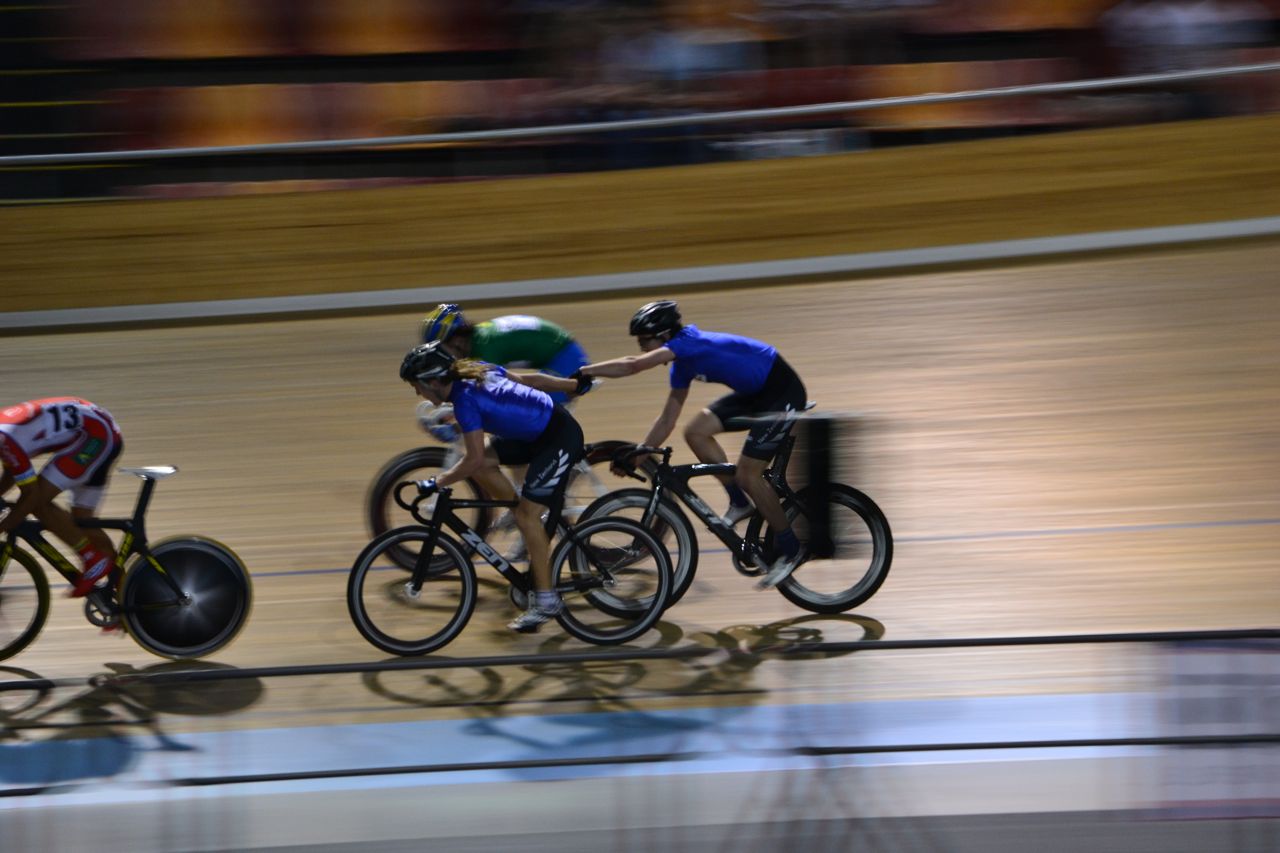
The Madison is that track event that most people haven't heard of but recognise when they see it. It's the one where the two riders do that weird hand-sling thing that looks very dangerous. For most people, that's as far as their knowledge goes.

The New Zealand duo do the sling

Created in Madison Square Garden, New York at around the turn of the century (that is, between the 19th and 20th centuries), the sport came about due to the need to rest riders. In those days, when track cycling was a major sport in the United States, cyclists were riding themselves into states of exhaustion. Events lasted 6 days and the riders would hardly sleep "and strain their powers until their faces [became] hideous with the tortures", as the New York times put it.

As a way to protect these riders, a new law was implemented that said no rider could ride for more than 12 hours a day. A promoter, unwilling to close his stadium for half a day, invented the Madison. In this way, riders would race for hours while their partner slept and rested. This allowed the racing to continue nonstop while also increasing the speeds and distances, which in turn kept the turnstiles turning.

These days, the races are much shorter, usually about an hour, but the general principal remains the same. Instead of resting and sleeping, however, the non-racing partner simply rolls around the track. The racing partner will do one or two laps and then "sling" their partner in. The sling is the most recognisable part of the sport. It allows the two cyclists to literally swap their speeds, so that the rester becomes the racer and the racer the rester.

von Bon and Lampater celebrate their victory

The aim of the game is to ride the most laps. If you ride more laps than anyone else, you win. Simple. But, there are also sprint points on offer every twenty laps or so. If you're on the same number of laps as another team, it goes to points to decide the winner.

At first, watching one of these races can seem confusing and impossible to follow. But after some watching, you become "Madison-ised". You start to feel the race and understand all the movements.

The stronger teams will attempt to ride off the front of the main group. If they can get all the way around and latch onto the back of said group, they're "given" a lap by the judges.

So, a boring sounding race, "200 laps around a track", is in fact a vibrant, bustling beast that has its own personality and absorbs you completely. For me, it is the most exciting and interesting track event. It is simply mesmerising.


Last night's Melbourne Madison was no different. There were some big names there. Most notably the Dutchman, Léon van Bon, who has Tour and Vuelta stage victories to his name as well as various top tens in races such as Paris-Roubaix, Paris-Tours, Amstel-Gold and Milan-San Remo. I have to admit I'd never heard of him. Neither had the guys there with me. But someone looked him up on their phone and announced his credentials. With a palmarès like that, we all suddenly became van Bon's biggest fans. There is something awe-inspiring, at least for a cycling tragic, about cyclists who have done the pro thing and come out the other end with big wins. So we cheered for our new best friend "Léon" and revelled in him and his race winning ways. I even caught myself at one point watching his legs go round and round and thinking, "the things those legs have done..."

Now in the twilight of his career, van Bon still knows how to ride a bike. Last night he raced with the (comparatively) young German Leif Lampater (no slouch himself, with World Cup wins and a National Championship under his belt). The pair powered to victory, finishing a lap up on the New Zealand pairing of Archibold and Scully, who in turn finished at least one lap up on the rest of the field.

Results

The racing was exciting, particularly the duel between the top two teams. The New Zealanders were always on the back foot but kept fighting to stay with the Dutch/German team. In the end, they didn't have it but they gave the crowd a good show.

Speaking of the crowd, there are some real characters in track cycling. Not that I spoke to any of them, but they sure looked like characters. These characters I speak of are old men. They didn't make up the majority of the crowd by any means, but they were well-represented and oozing style. They wore suits and old men hats and held stopwatches. They clung to the race program as if it were their bible, and jotted down the victors' names and times throughout the evening. I like to imagine that they had been born to the track, raced on the track, had their first kiss at the track, coached people at the track and now watch the track. Maybe afterwards they go out and drink ouzo, smoke Gauloises and talk about cadence and "the young ones to watch".

Thursday, March 3, 2011

Down Hill Chile Style


Some gnarly urban DH from Chile.  With the cheering crowds and the wayward dog it's just like the Tour de France.
I'm tempted to say, "I'd love to ride this" but the reality is if I got the chance I would probably fall off at, or just after, the 10 second point of this video.  Enjoy!

Wednesday, March 2, 2011

"...probably the greatest video ever made."

One comment posted on this video was "This is probably the greatest video ever made."
I don't know about that but it's definitely very bloody good.


Tuesday, March 1, 2011

Brazilian Critical Mass Mowed Down by Crazed Driver

A group of Critical Mass riders in Brazil were last Friday mowed down by a Volkswagen driving at what looks to be very high speed.  Apparently fifty cyclists were hit and two are in a critical condition.  Looking at the footage, I cannot believe that no one was killed on impact.


The driver, one Ricardo José Neis, fled the scene and dumped his car.  He was apprehended on Monday and may faces charges of attempted homicide.  He claims that the cyclists began beating his car and that he feared for his life and panicked.  The chief investigator, however, describes this claim as "fanciful" and the cyclists themselves report he drove behind them for two blocks and then simply accelerated through them.


Be warned, this footage is a bit shocking.


The event is reminiscent of an accident that took place in Mexico in 2008.  In this case, the driver was drunk and fell asleep before colliding with the group, killing one and injuring ten.

Cyclists hit in Mexico


I hope this doesn't put anyone off cycling.  The only good thing about freak accidents and freaks is they don't show themselves all that often.  But when they do...freaky.